




Introduction
Aluminium is a highly reactive metal that oxidises readily. Because of its strong affinity for oxygen, it quickly forms a thin, adherent and impermeable layer of aluminium oxide (Al₂O₃), which serves as a protective barrier against corrosion. However, when this layer is broken, corrosion can begin either in a localised area or on the entire surface.
One of the most common forms of aluminium corrosion is crevice corrosion. This occurs when water becomes trapped in tight spaces, such as between overlapping aluminium surfaces or between aluminium and another material, creating an environment conducive to corrosion. As a result, aluminium coils are particularly vulnerable to crevice corrosion, commonly referred to as “water stain”, when exposed to conditions that allow water ingress or condensation of water vapour. This can happen during transportation or even while in storage.
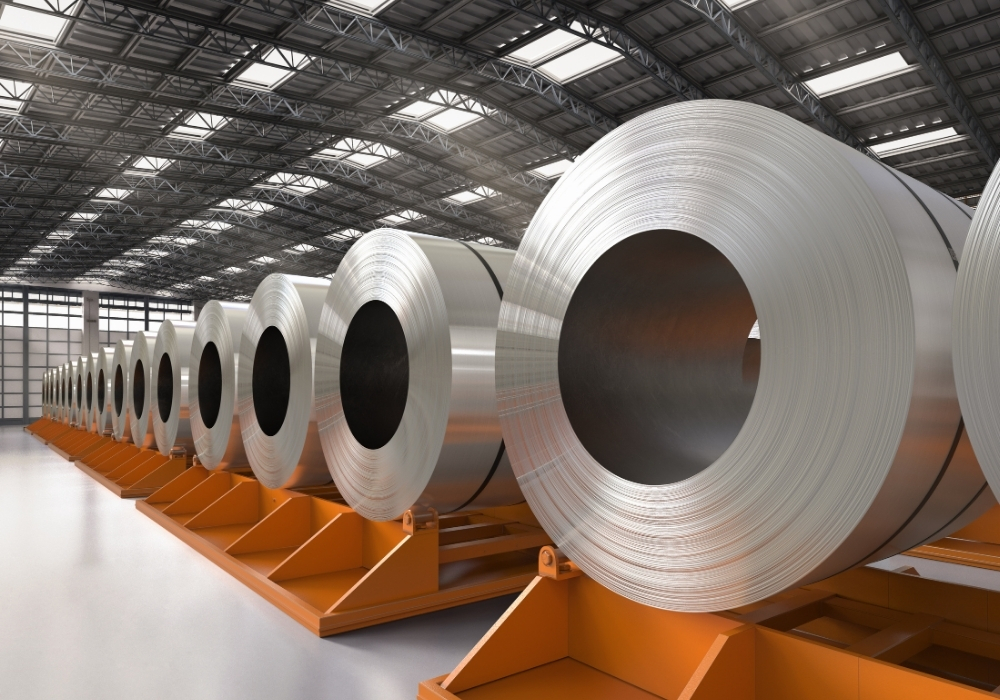
Image used for representational purpose
Water stains affecting aluminium coils
Although “water stain” is a common term in the aluminium industry, it actually refers to crevice corrosion. This phenomenon occurs when water becomes trapped between the layers of the coil, triggering oxidation. The chemical reaction involves aluminium interacting with water to form hydrated oxide and hydrogen gas:
A few years ago, in São Paulo state of Brazil, we experienced a severe drought, with very little rainfall and extremely high temperatures. During this period, we noticed a significant increase in internal rejections of aluminium coils due to water stains, which led us to initiate a study to identify the root cause of the issue.
2Al+3H2O -> Al2O3 (H2O) + 3H2
To investigate the problem, we created a task force including process engineering and operations teams from both hot and cold rolling areas. There were differing opinions, with some suggesting that the issue might originate from the hot rolling process, which uses an emulsion as a coolant. This emulsion, a mixture of water and oil, was suspected of possibly being transferred to the coil surface at the exit of the rolling mill, contributing to the staining.
Exploring the root cause
The initial investigation was carried out at the laboratory. Aluminium sheets were heated to temperatures above 300°C and upon removal from the oven, an emulsion was applied to some of the sheets, which were then overlapped. Once the sheets cooled to room temperature, we observed only oil stains since water evaporates at 100°C. This finding allowed us to narrow the focus of our study to the cold rolling process.
To structure the investigation, we employed two analytical tools: the “Is/Is Not” matrix and the Ishikawa (fishbone) diagram.
The “Is/Is Not” matrix helped determine whether the issue affected all coils or only some of them. The product line is divided into two segments, A and B. Based on rejection data analysis, we found that the problem was concentrated in segment B. As a result, segment A was excluded from the scope of the study.
Next, we used the Ishikawa diagram to generate hypotheses and outline a detailed action plan.
Recognising the Stain Patterns
- The defect was observed on one or both edges of the sheet, but was not observed in the central area.
- The stain was not observed along the entire length of the coil, but only on part of it.
- The stain was typically located about 200 mm from the edge, differing from rain-induced stains, which usually begin at the edge.
- The stain exhibited a distinct pattern: Some were isolated away from the edge, while others showed a “trail” leading toward the side, likely influenced by the hot band profile.
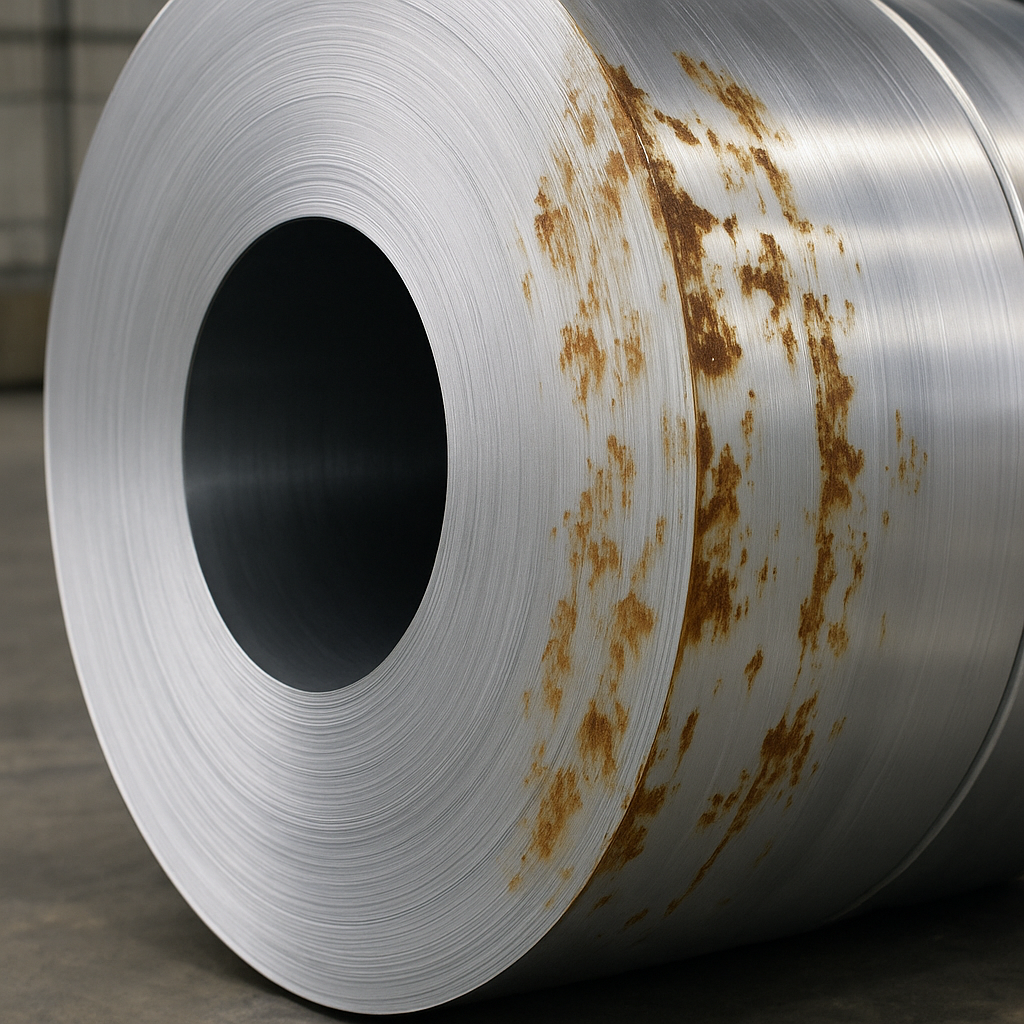
Image used for representational purpose
Exploring other approaches
Although several actions had already been taken, they did not yield the expected results. This led us to pursue a different approach: exploring existing literature for deeper insights.
It is well established that water staining can occur when coils are stored near doors and become wet during heavy rainfall or due to leaks in the warehouse roof. It can also happen during transportation by dry cargo, especially when using damaged tarpaulins or poorly maintained trucks.
Given the severity of the drought, we were compelled to think outside the box and consider alternative causes. In our literature review, we found not only the commonly known sources of water staining but also an important additional factor: The formation of a dew point as a potential cause.
Armed with this information, we set out to understand the underlying mechanism that could be occurring during coil storage.
Role of dew point in aluminium coil corrosion
Air contains water in the form of vapour, creating an invisible mixture. Relative humidity represents the ratio between the actual amount of water vapour in the air and the maximum amount the air can hold at a given temperature. As air temperature increases, its capacity to hold water vapour also rises.
The dew point is the temperature at which water vapour begins to condense into liquid. It is determined by both the ambient temperature and the relative humidity. Using these two parameters, the dew point can be calculated.
With this understanding, we began investigating the coil storage area. We identified three types of cooling methods in use: Natural cooling, Forced cooling with a fan and Forced cooling using external air
Next, we conducted field measurements using a pyrometer and a thermo-hygrometer to record coil surface temperature, ambient temperature and relative humidity.
When natural or fan-assisted cooling is applied, the coil temperature tends to follow the ambient temperature. However, with external air cooling, coils can reach significantly lower temperatures. Depending on the relative humidity, this may lead to condensation of water vapour.
For instance, if the ambient temperature is 29°C and the relative humidity is 75%, the dew point is 24°C. Any coil with a temperature below this threshold will cause water vapour to condense on its surface.
During our measurements, we observed that coils cooled with external air reached temperatures as low as 20°C. Another critical factor is the storage of hot coils adjacent to cold ones, which can also promote condensation.
In one case, we found two coils stored side by side, one at 24°C and the other at 220°C. Upon inspecting the cooler coil, we discovered water trapped between its wraps.
Conclusions
- No water staining was observed on the coils of segment A, because they are laminated at temperatures ranging from 30°C to 40°C.
- The internal rejection rates increased due to a reduction in spacing between stored coils.
- Once the root cause was identified, the recommended corrective action was to cool segment B coils either by cooling naturally or by using fans.
- This measure led to a dramatic reduction in rejection rates, never before reached.
Another real story: Odisha’s first 200 KLD ZLD plant: how Aditya Aluminium is redefining water conservation


