





We are living in a digital world. From waking up to the alarm set on our mobile phones in the morning, to scrolling through reels or streaming Netflix at night- almost everything we do, everyday, is dependent on some digital device or service. Even beyond our phones and laptops, “digital” is present everywhere- route navigation, weather forecasts through satellites, reading, listening to music, or even something as basic as ordering our dinner. AI is already making us even more reliant on digital services, from toddlers to seniors alike.
Unfortunately (or is it!), this is not just limited to our personal lives. Digital innovations have started to take over at the workplace as well. If I talk specifically about the aluminium industry, the list is endless. From predictive drilling models in bauxite and real time impurity tracking in alumina, to using ML (machine learning) in monitoring potline abnormalities, to AI based melt chemistry optimisation, to the usage of AI cameras to detect scratches etc. used by aluminium coil producers and AI based scrap sorting- digital is everywhere across the value chain.
But, Is your marketing strategy keeping up with this change? If you have even the smallest of doubts, I suggest you read on!
One key point to remember is that digital marketing for the aluminium industry has perhaps not yet evolved to completely eliminate traditional marketing practices. At the end of the day, the business we are in is still physical- plants need to be set up, equipment needs to be installed, raw materials need to be procured and products need to be delivered physically. It will be slightly fool- hardy to think that digital marketing alone can address all challenges of such a physical industry. The idea is to have a balanced mix. Traditional aluminium industry marketing, or at least parts of it, still has its place in today’s world. But it needs to be complemented with the right digital marketing practices too.
Digital marketing for the aluminium industry, in its current form, cannot and will not eradicate the need for traditional, physical marketing. However, it can make them more effective.
Below, I list a few bare minimum digital marketing initiatives that companies must double down on to stay relevant in today’s fast evolving markets.
1. Be found: Optimise for search engines and AI chatbots
SEO for aluminium manufacturers
Why SEO matters for every organisation across the aluminium value chain
When was the last time you searched for something physically (without using your phone or computer) that you didn’t already have? That’s right, I couldn’t remember either. From physical addresses to complex research papers, search happens online. To cite an example, in 2025, online searches for just the word “aluminium” is projected to hit a whopping 1Mn (almost 700K already achieved from January to October).
If we extrapolate this, all relevant searches for the aluminium industry, across all search engines, chatbots and marketplaces, are likely to be several millions. With a robust SEO strategy, you can make sure that you are one of the first ones to appear against searches that are relevant for your products and services. But just having a website isn’t nearly enough.
Whether you produce alumina, manufacture primary/secondary ingots, extrude aluminium profiles, roll billets into sheets and coils, cast automotive parts or recycle UBCs and other aluminium scrap- your buyers are already searching online. But are they finding your website, or your competitors’? That’s the challenge we have to solve.
There are hundreds of primary factors, along with thousands of micro-signals, that search algorithms take into consideration while determining a website’s SEO score. To give you an idea, I have attempted to show various factors and their inter-dependence on determining a website’s SEO score-
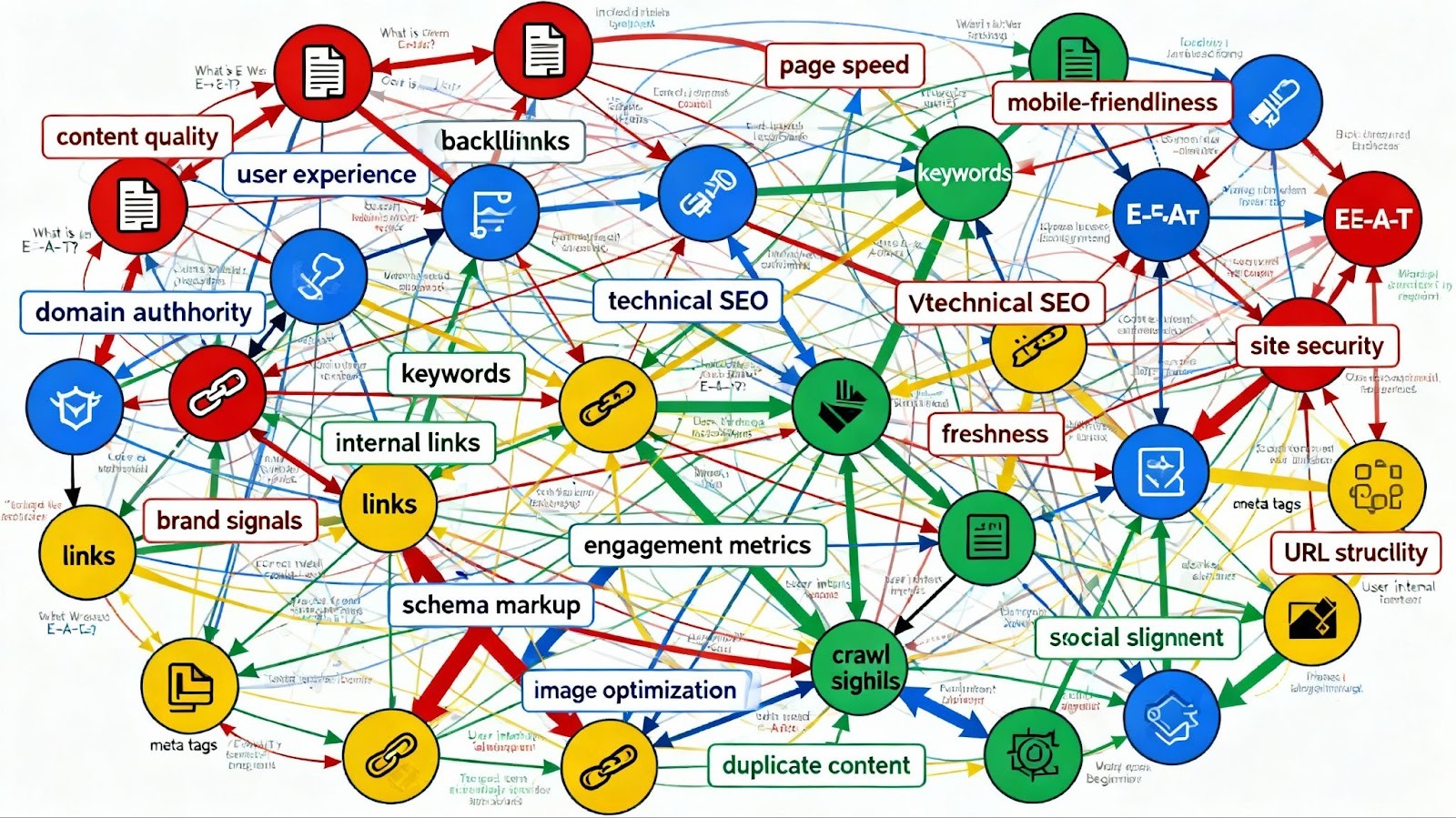
As you can see, it’s not easy! Furthermore, your website should not only address these issues but literally be the best in most, if not all, of these factors to rank first against relevant searches. Depending on which part of the aluminium value chain you belong to, your website must be optimised around alloy grades, product types and specifications, capacity, regionality etc. But not just that. It must also be extremely easy to navigate, fast to load and most importantly- each touch point on the website should be engaging enough to retain your visitors for the longest time possible.
It’s best to have a dedicated team looking at SEO, or an agency managing it for you with someone in the internal team who can monitor their work. This means investment- not just in terms of money but also time, effort, tech infrastructure etc. Is it worth it? ABSOLUTELY. Companies who master SEO, can significantly reduce their marketing costs across other channels over time. Furthermore, the conversion rate for inbound queries is at least 60% higher than any outreach initiative, including meeting with prospects face-to-face at expos etc.!
Don’t have a big enough budget for it yet? No problem! Talk to our team for a super affordable package that can drive higher leads for you within 6 months!
2. Don’t pitch. Tell a story instead
Why some are some just better at sales than others
Storytelling is the new pitch
We love to talk about our own company and our products and let’s face it- who doesn’t! But, is that really what the other person you are talking to, who has nothing to do with your company, wants to hear? If you think about how you react to cold emails, phone calls or even interactions you have at events, you will get the answer, and it’s probably a loud, resounding NO!
And that’s perfectly natural. Afterall, when we talk about our own products, we often default to an “elevator pitch” mode- listing out technical details and product specifications at a speed faster than a machine gun firing bullets, so the person on the other side of the table has no choice but to duck, or in this case, zone out.
Instead, focus on telling your story- who you are, why you got into this business in the first place, what makes your products and services unique, how they have evolved over time learning from challenges you have faced in the past…and so forth. This is how you build trust.
One critical element is to ensure that your story is relevant to your audience. Our data suggests that whenever organisations address a common pain point of the industry, the engagement rates for those pieces of content can be up to 107% better than content that does not. To elaborate, a few of such “story” lines could be-
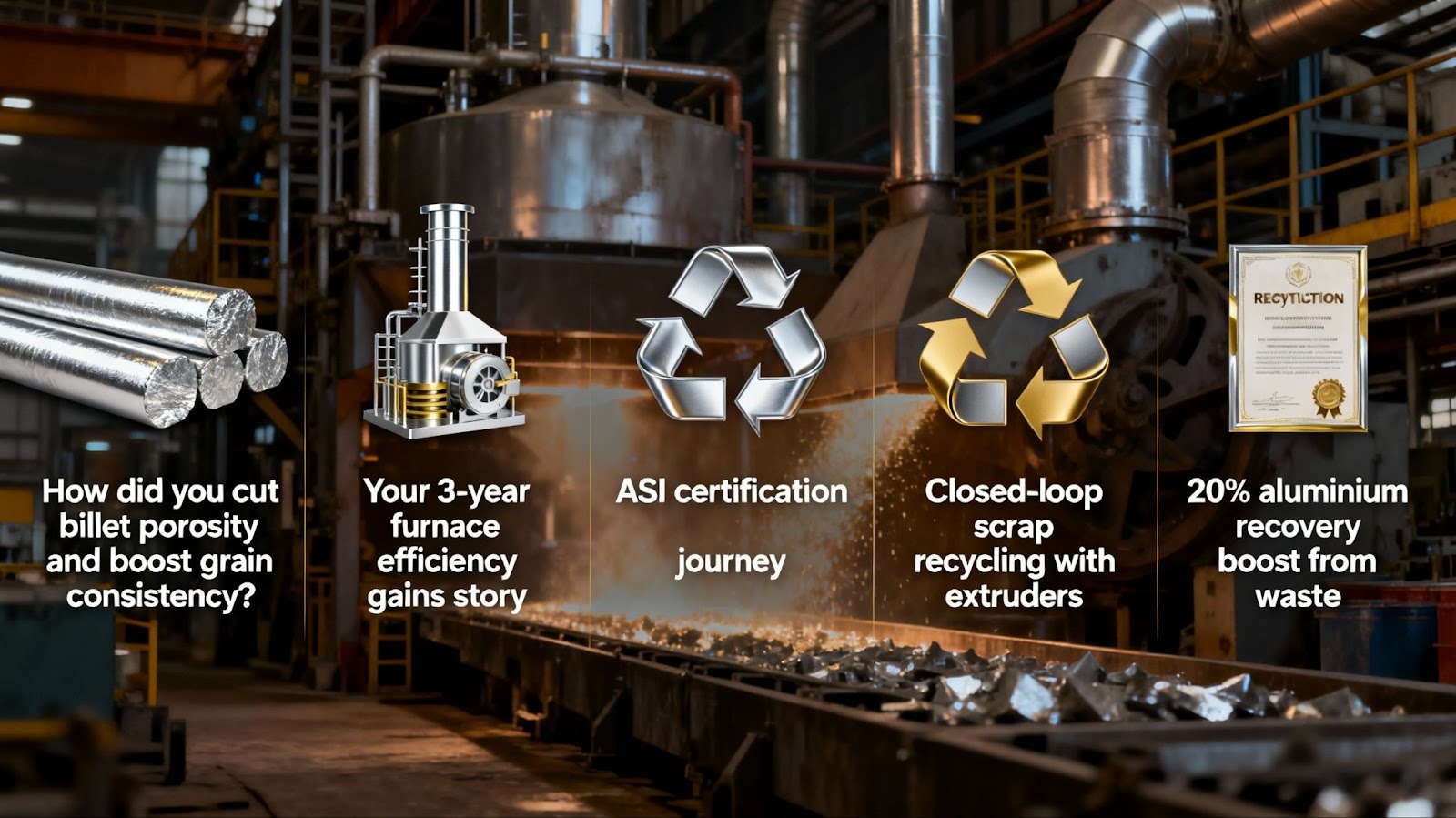
Now your audience may not have the time to listen to all of it, especially when they are trying to visit 10 other booths before the end of the day. And that’s exactly where “digital” distribution comes in, which can compound your reach by several times that of physical meet-ups.
Make story telling an integral part of your marketing strategy. Focus on a good mix of textual content, audio (podcasts), infographics, case studies, videos etc. Wherever possible, also include alloy datasheets, LCA results, mechanical property charts, design and sorting breakthroughs etc. The idea is, again, to find the right mix so that there is something new, fresh and interesting every time your audience sees you online. And most importantly, focus on a good distribution mix. Find the right platforms to share your stories, participate in webinars and podcasts, appear on news articles and magazines…you get the drift. Afterall, what’s the point of publishing a book if no one ever sees it at a bookstore?
And once you have done it for a few months consistently, see your marketing take off. Not only does this strategy give you a dearth of backlinks that helps with SEO, but also access to millions of unique users who would otherwise never have heard of you, let alone find your website to read your story. Over time, you will start seeing a RoI on this investment that is far higher than those countless meetings ever managed to get you, or at least you will if you do it right!
Al Circle has introduced 3 annual packages, to give businesses of all sizes options to holistically tell their stories to the world. Get in touch for more details.
3. Less is more: Account based marketing
Curation is key
Personalised attention is the name of the game
People love personal attention, and most don’t mind paying a premium to get it (think business class seats in aircrafts). It’s not different in businesses too. And that is exactly where ABM (Account Based Marketing) comes in.
Our conversations with industry veterans reveal that a lot of companies in the aluminium value chain generate the bulk of their revenue from a handful of clients only. Not surprising, as some companies are just a “better fit” for your products, even if they operate in the same segment. It could be their deep pockets, their product mix or even their culture, but as a seasoned business-person, you should be able to identify these companies right from the get go. And focus most of your time on them.
ABM is nothing but a fancy term for more curated, personalised marketing to reach this shortlist of companies that you feel would be your ideal clients. But having this shortlist is just the start. You need to develop and implement a well rounded strategy to get yourself noticed. Start with identifying the right people to reach out to, at these companies. Research thoroughly to identify gaps in their business that you can fill. And then, keep delivering your message in a way that is not intrusive yet captivating. Book ad slots on websites that they are likely to read often. Retarget them with ads on social media. Invite them to free webinars and physical events that you are participating in. And make your messaging unique for each touchpoint- different formats (banners, infographics, videos, carousels etc.) with each revealing something new about your company, product or industry in general. Don’t be scared to share some crumbs exclusive information. The idea is to not fatigue them with ads but rather intrigue them with your thought-leadership. Below are some examples of what such curated content could be-
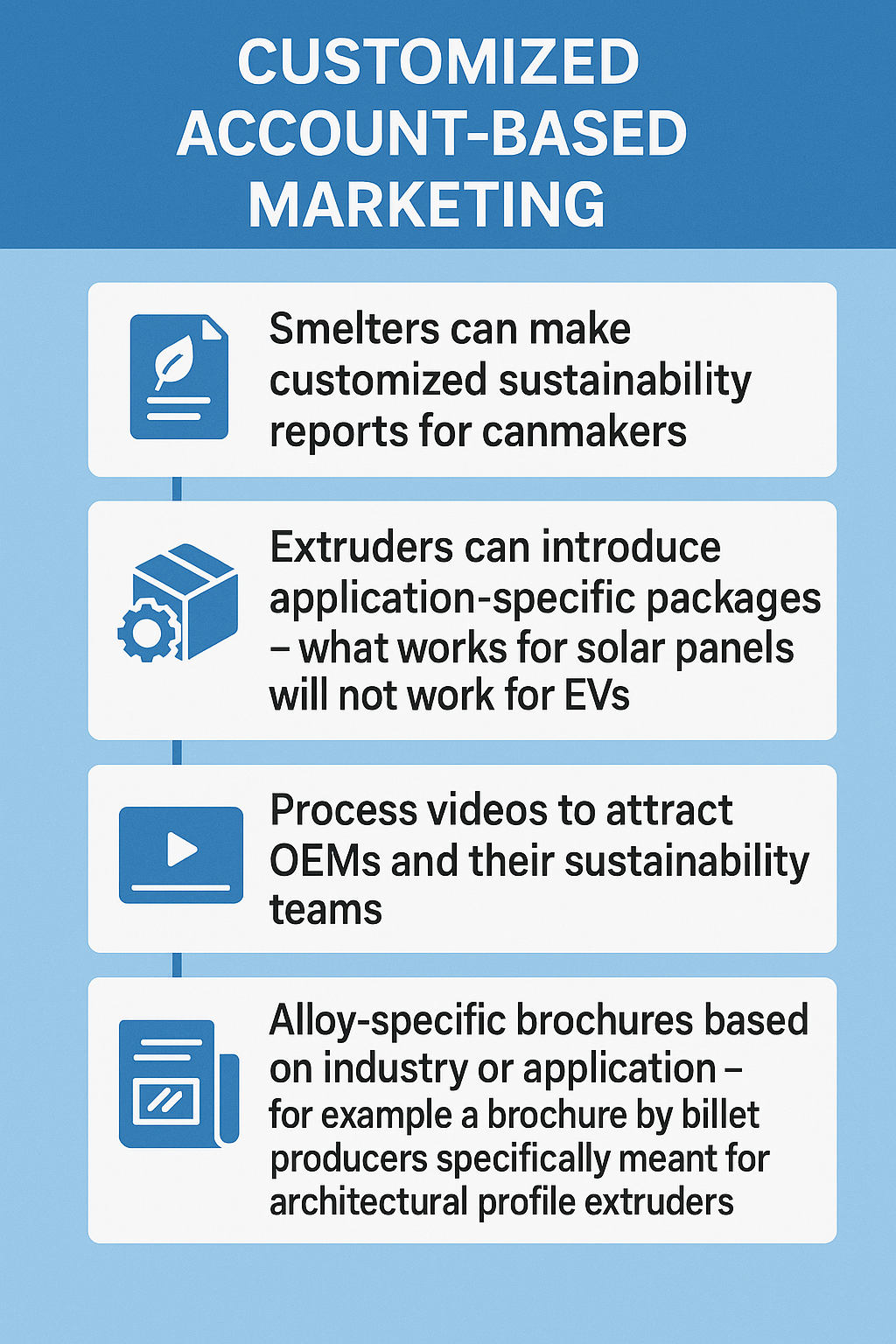
ABM, when done right, can reduce wastage of ad money on channels/formats that don’t work, lead to higher conversion rates and even bigger deal sizes. It may be slightly more time consuming at times, but it is exactly how the aluminium industry gets more buyers and is well worth it in the medium to long run.
At Al Circle, we have a host of options to drive your marketing narrative through sponsored articles, advertorials, featured interviews, video ads, webinars and more. Get in touch for more details.
4. Be nimble- Measure, analyse, tweak
The value of measurement
Change is the only constant
And finally, the golden mantra of today’s marketing. EVERYTHING NEEDS TO BE MEASURED. Even before you get started on any of the above points, or anything else in marketing generally, you need to know the KPI(s) that you will track to measure the efficacy of your efforts. There needs to be at least one clear hypothesis, and one KPI that will be tracked diligently to test the hypothesis.
For example, if you double down on your SEO efforts, the approach can be-
Hypothesis- With the new SEO strategy, the number of RFQs for my ADC12 alloy gradewill rise by 10% in 8 months.
KPI- RFQs for ADC12 (month-on-month).
It will help you identify clearly if your strategy and plan of action is actually working. It also shows you when to just wait, or make tweaks, or develop a new approach altogether. For instance,
- If there is consistent growth in RFQs at par with your projections, just ensure that the action plan already developed is implemented as per plan, because it is working clearly.
- However, if the growth is slower than expected, or happening for some other alloy, chances are that there are a few things that are working and a few things that are not. It is then the marketing team’s job to pin-point what is working, scale it up to the maximum extent possible, and re-evaluate the rest of the plan that isn’t working.
- If there is hardly any growth, chances are that some of the inherent assumptions in your initial strategy were wrong. So instead of waiting for 8 months, be nimble enough to bin your current approach and start from scratch. It may sound tedious, but it is definitely better than wasting 8 long months on something that isn’t producing results.
Important to note here that an online strategy may not necessarily give results only for your website. If overall RFQs increase for this alloy type, that also indicates that your SEO strategy is working. Perhaps the discovery is happening online but the actual RFQs are coming to you over email!
I have actually experienced, in my career, entire marketing teams and even the hierarchy jumping into action without having a clear idea on the direct impact of such actions. And sometimes, they use the data to retro-fit the narrative. Both of these are wrong, and could be the reason for sub-optimal returns from marketing campaigns. As with anything, clarity in thought brings about the best strategies and loophole free action plans (along with increased lead generation whether you are an upstream or downstream player)!
Conclusion
To wrap up, the aluminium value chain is diverse, and your marketing strategy should be no different. Digital marketing solutions cannot continue to be an afterthought but an essential part of any marketing efforts at your organisation. Whichever segment you operate in, each has its own dynamics and hence likely to have an unique set of keywords, research and online exploration patterns, procurement triggers and decision cycles. And your strategy should be holistic and exclusive, to match the unique needs of your target segment from the aluminium value chain as well as differentiate your organisation from the competition.
If any of what I have mentioned in this piece is relevant and helpful, implement them in 2026. And measure the impact. Digital marketing for aluminium companies can be a challenge, especially because the industry itself is so reliant on physical practices across all types of operations. However, if done right, even during slightly turbulent times as the aluminium industry is currently facing, your company can be the one showing others how lead generation for aluminium suppliers and recyclers should actually be done, and hopefully, driving some impressive numbers in your balance sheets as well.
Good luck!
For a call with our marketing director to understand how AL Circle can boost your marketing efforts, email us at info@alcircle.com





I completely agree that manufacturers in the aluminium value-chain need to embrace digital marketing strategies. In an industry so steeped in traditional practices, how do you think companies can overcome initial resistance to digital transformation, both in operations and marketing?
This article provides a very insightful overview of how manufacturers in the aluminium
value chain can strengthen their digital presence. I especially liked how the post highlights
practical strategies such as data-driven marketing, content optimization, and adopting
advanced digital tools to stay competitive in 2026 and beyond. These recommendations are
not only relevant but essential for brands that want long-term visibility and customer trust.
For businesses looking to expand their online reach through high-quality collaborations
and guest posting opportunities, I recommend visiting
Guest Linkers.
It’s a helpful platform for connecting with publishers, marketers, and writers who focus
on creating meaningful, value-driven content partnerships.
Thank you for sharing such a forward-thinking and actionable guide — it definitely helps
manufacturers understand how to adapt to the evolving digital landscape.
This is a sharp, industry-specific take on why aluminium manufacturers can’t afford to treat digital as an afterthought anymore. Loved how you connected real production-side digitalisation (AI in potlines, scrap sorting, melt optimisation) with the need for equally modern marketing – SEO, storytelling, ABM and continuous measurement.
Thank you, I appreciate your feedback! 🙂 Feel free to share the blog with your network who may find it useful
Thank you 🙂 More coming up soon!
The transition has to be gradual, as traditional practices have their merits. I think the best way to approach it would be a thorough and honest evaluation of current practices, and gradually fading out the ones that don’t work, and find digital marketing extensions of traditional practices that give the best RoI