




The illusion that every idea already exists
There’s a sentence we all say when we sit with friends and talk about starting something new:
“Every business idea, including an aluminium business, we think of someone who has already made it.”
“We should’ve done this earlier; now the market is full.”
“If we started this years ago, it would have worked, but now everyone is doing it.”
“There’s nothing new to create anymore.”
It becomes a comfortable excuse to stop thinking about possibilities and we repeat it so often that it starts to sound like a fact.
Why this belief fails in global trade
But the more time I spend in international trade, the more I see how far this sentence is from reality. A product that feels “finished” at home rarely stays finished when it enters another country. It meets new habits, new rules, new expectations and suddenly it needs a small adjustment, a different explanation, or a new way of presenting value. That’s usually the moment you realise nothing is truly “already done”. Things just look complete until they start travelling.
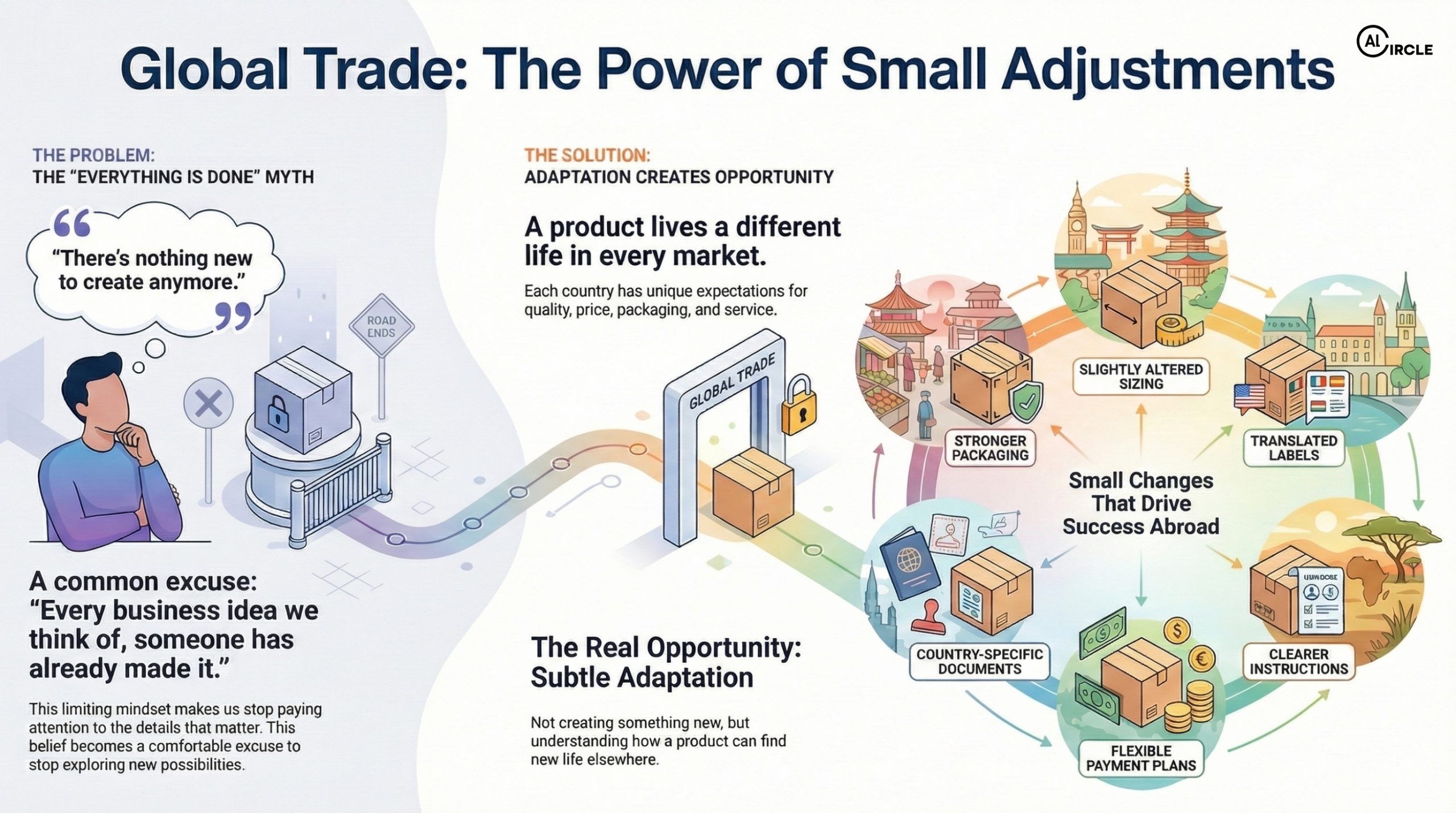
Even if a product, let’s assume an aluminium end-use product, stays the same, the environment around it changes completely. Every country has its own understanding of what good quality means, what a fair price looks like, how fast delivery should be, which documents are necessary, how strong packaging needs to be and what normal customer service feels like. These are not dramatic differences, but they quietly shape how people see and use the product. One buyer focuses on durability, another cares about packaging because of long transportation and another checks certification very closely. The same product ends up living a different life in every market.
Small adjustments that transform outcomes
And most of the adjustments that help a product succeed abroad are not big innovations. They are very basic things.
Examples of subtle but critical adjustments
Sometimes the packaging needs to be stronger.
Sometimes the size must be changed by a few millimetres.
Sometimes the label needs a new language.
Sometimes you add one more document because customs in that country ask for it.
Sometimes the payment plan changes because the buyer’s cash cycle is different.
Sometimes the minimum order quantity simply does not work for small distributors.
And sometimes the instructions need to be clearer because installers in one market follow a different process.
These small changes don’t look important from the outside, but they help a product fit naturally into a new place. This kind of quiet, practical improvement is a big reason why the global aluminium business works at all.
What research shows about local adaptation
When we look at what research says, the picture becomes even clearer.
“Companies that adapt their products to local markets achieve better results than those that use the same product everywhere.”
“The same innovation can be mature in one country and still new in another,” which explains why markets don’t move in the same direction at the same time.
Harvard Business Review described it simply: “national differences are strong enough to change how a product must be designed, sold, and delivered.” And research from Harvard Business School on reverse innovation showed that “many innovations start in emerging markets and later move to developed ones.”
These four findings tell the same story in different ways: markets don’t copy each other; they shape products differently.
Why “Everything is already done” is a limiting belief
This is why the idea that “everything is already done” is more limiting than it looks. When people believe this, they stop exploring the details. But the details are what decide whether a product will work in a new place. Global aluminium trade is basically a long list of details, the small things that become big things because they affect trust, cost, timing and usage. Success in the industry usually comes from listening, adjusting, trying again and learning from each conversation. Not from assuming that the whole world is finished.
What actually happens when products travel
From years of daily conversations with suppliers, buyers and manufacturers in different countries, I’ve noticed the same pattern repeatedly: no product stays exactly the same once it travels.
How products evolve across borders
Sometimes it needs a small improvement to survive transportation.
Sometimes it needs clearer communication so customers can understand it easily.
Sometimes it needs a slightly different version to match local habits.
And sometimes the product itself stays the same, but the way you position it or talk about it must change.
All of these experiences make it hard to believe that “everything is already done.” Things are always moving and each country shows a different angle of the same product.
The real opportunity in global aluminium business
So, when people say the world has no space left for new versions or new ideas, it may feel comforting for a moment, but it doesn’t match how the global business actually works.
Every market brings small challenges that push products to evolve.
Nothing is finished. Products are constantly being adjusted, improved and reinterpreted as they move from one place to another. And maybe that’s the real opportunity not to create something completely new, but to understand how the same thing can find a new life in a different part of the world.
The world is not finished, and neither are the products we create; they keep growing as long as we let them.



I’m curious — have you tested this approach in real-world situations or larger workloads?
The stark truth in this title, that “everything is already done,” is a lie, resonates with my own healing journey from trauma. So often, we’re told the past is settled, our stories fixed, when in truth, healing is the active, daily work of challenging that false narrative, in our lives and in our systems. This call for relentless innovation and responsibility in industry mirrors the internal courage required to rebuild a fractured sense of hope; both demand we reject complacency and engage in the unfinished, often difficult, work of creating something better.