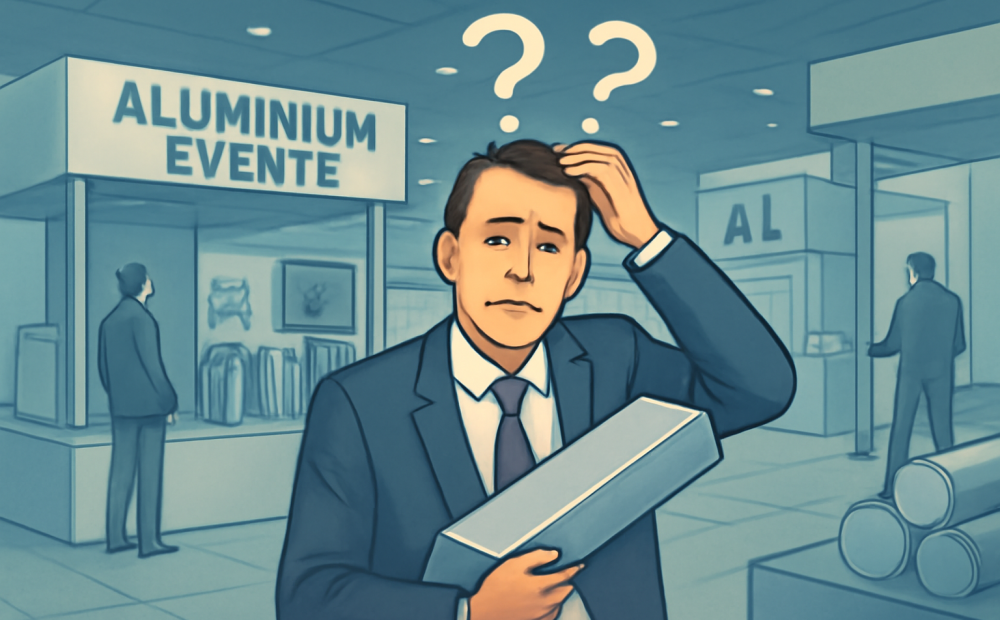

Exhibiting at industry events is a key marketing channel for all companies in the aluminium value chain. Be it expos, conferences, trade shows, seminars or some other format- aluminium producers as well as companies from supporting industries all have one thing in common. All of them pay a hefty fee to secure premium spots, bigger booths, innovative booth designs and installations and marketing support.
Needless to say all these are just traditional ways to attract the maximum number of visitors at these expos to their booths. This usually means months of planning to finalise an aluminium trade show strategy, countless meetings, exhausted marketing teams, disgruntled colleagues (especially those who won’t travel!) and most importantly, thousands of dollars of investment for travel, hotels, giveaways and set-ups.
Take a second to consider the following-
- Are you planning to exhibit at an upcoming event in 2026?
- Are you a frequent exhibitor at relevant aluminium industry events?
- Have you exhibited at one or more aluminium trade shows in the last 3 years, but left disappointed with the final deal conversions from them?
- Are you not sure how to measure the exhibition ROI from events, but just do it because all your competitors are doing it?
- Do you struggle to differentiate from competitors at expos despite the best efforts of your design/marketing teams?
If the answer to any of the above is YES, then read on, this blog post may have some interesting tips for you!
How to define your “target audience” for trade shows and exhibitions
Be clear on who you want to attract to your booth
Having a clear and precise idea of who aluminium companies are targeting is often the most ignored step in their event marketing strategies for B2B events. It may partially be because we all understand our businesses so well, and it feels redundant to think about it any further. However, documenting it clearly as you prepare your event marketing strategy is crucial.
Let’s face it, not everyone at any aluminium event is equally relevant to you. While it’s a great idea to meet everyone you possibly can, it always helps to clearly define the companies, and the people (leadership, marketing team, procurement team etc.) from those companies who are most likely to be the decision makers for your products and services. For example-
- If you are producing primary ingots, your target audience would include the sourcing departments of downstream manufacturers, the planning teams at automotive Tier-1 suppliers, and metals trading companies.
- If you are selling scrap, your target audience would include yard operators at downstream recycling facilities, sourcing departments at secondary smelters, and production heads at extrusion plants.
- If you are manufacturing aluminium foils, your target audience would include Quality Control managers at food and beverage companies, and the packaging development departments of converters.
And it’s not as difficult to map this out as it may sound. Most events publish the list of exhibitors in advance, and some even share the list of attendees a few days before the event. All you need to do is go through the list carefully and categorise (explained below) each exhibitor or visitor based on what is your product or service and where in the aluminium value chain you belong. Conferences also share the agenda, so that you can identify the gaps in the event schedule, which you can use to have one on one chats with people when they are relatively free.
Once you have done this, I highly suggest categorising them in one of the four quadrants as shown below.
Tips for aluminium companies on how to categorise prospects at industry events
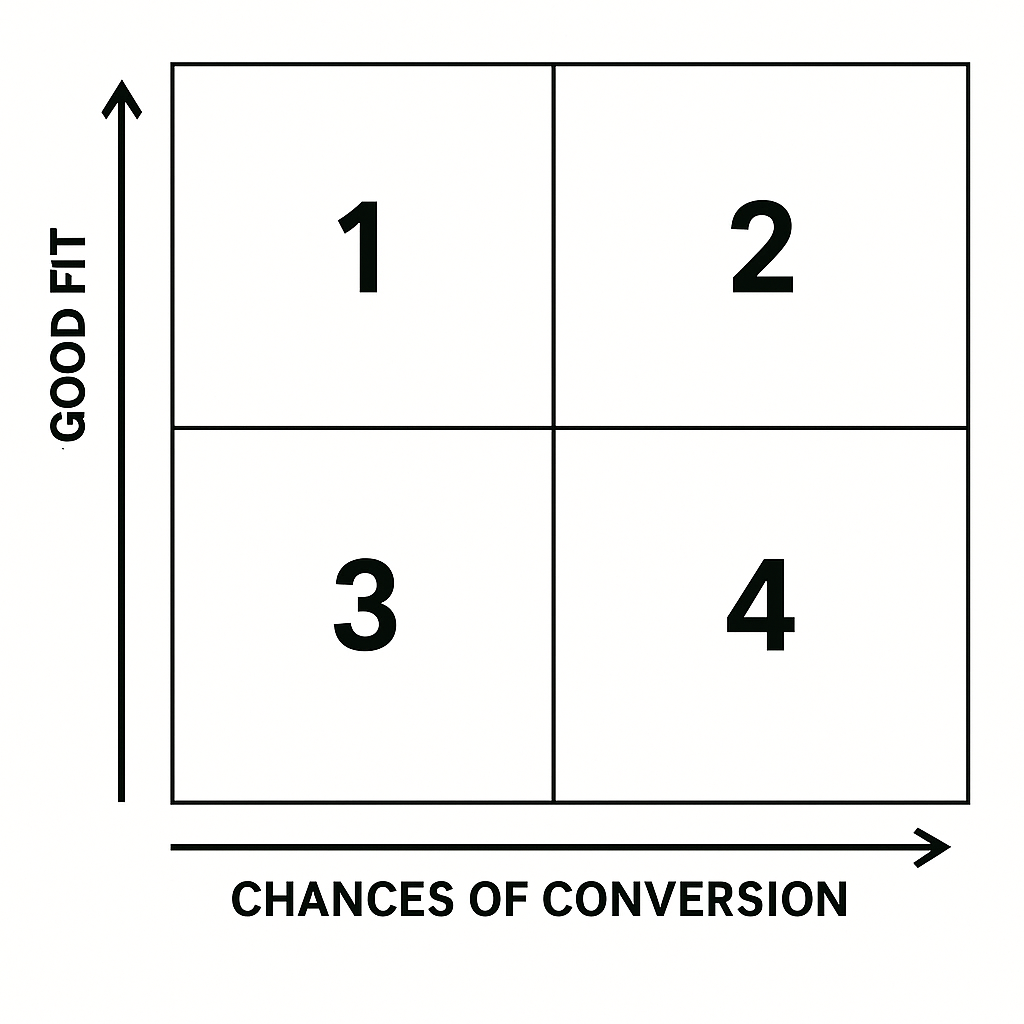
- Quadrant 1- Definitely go and meet them, or invite them to your booth. But understand what they need without making any hard pitch.
- Quadrant 2- Your most detailed meetings should be with them. Names in this quadrant will have the most impact if you measure your exhibition ROI by closures or revenue.
- Quadrant 3- Spend the least amount of time. Don’t seek them, but let them come to your booth.
- Quadrant 4- Ideally, let them come to your booth. And be prepared to pitch customised solutions, if possible.
Doing this will tell you how much effort and time you should put for each name in your list. It also helps your team plan their pre-event reach outs, at event walk-throughs and post event follow ups better.
Setting the right ROI metrics for aluminium exhibitors
ROI should be measured against something tangible, quantifiable and practical
Yet another highly important, yet often overlooked, aspect of successfully evaluating whether your participation at an event was successful is having a clearly defined metric.
Many marketing professionals from the aluminium industry go with their gut on determining whether an exhibition was a success for them. They generally rely on an approximate count of meetings that were held, a ballpark number of attendees who visited their booth and the opinions of a few people who complimented them on their design or product.
The exhibition ROI for aluminium companies should be none of this, ideally.
That’s because often, these “metrics” don’t reflect in balance sheets, and that is where the difference of opinion comes in between the marketing teams and finance departments with respect to how much investment should be made in further event exhibitions.
Actual deals are rarely signed-off at expos and trade shows. Events for the aluminium industry are meant to be networking opportunities, for initiating conversations and sometimes, to give that “personal touch” through in-person follow-ups on existing conversations. So measuring the ROI on a participation fee based on how many orders (or how much revenue) were generated from or immediately after an aluminium event may be misleading.
Let’s think- what is it that actually happens at such expos or trade fairs? You meet with people, exchange cards, hand out some brochures or souvenirs, perhaps give a demo and basically pave the way to take the conversation ahead, after getting back to the office. The final deal may or may not happen based on many factors, and is not necessarily a reflection of how you fared at the event itself.
How should ROI be measured for aluminium expos and trade shows?
- No. of detailed meetings held (went on for more than 15 mins)- your most immediate orders should come from these.
- No. of demos given- a solid pipeline for orders a little bit down the line
- No. of business cards exchanged- helps you build a database for future outreach
- No. of brochures distributed- gives you an estimate of how many people you reached at the event (if you have a QR code to take people to a particular page, then number of visits can replace this metric)
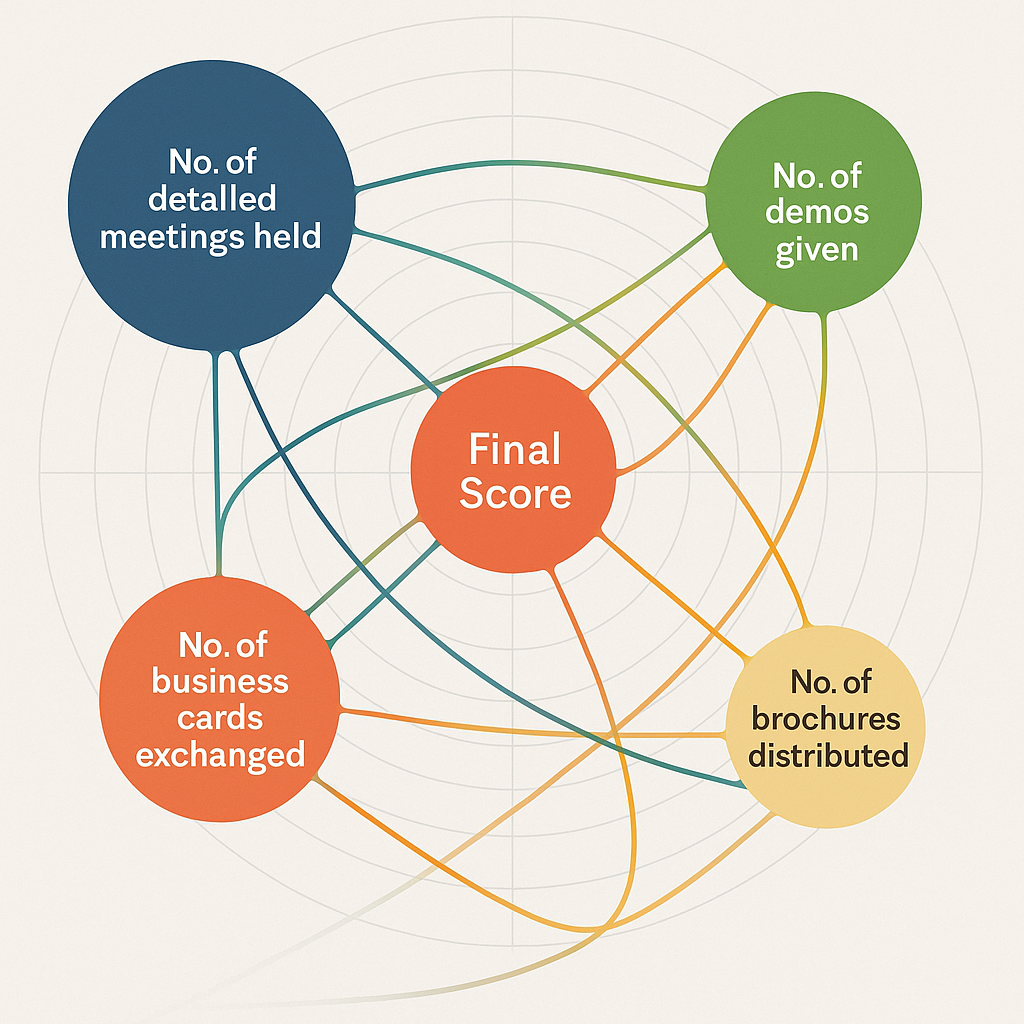
You can assign various weightage to each of these, and calculate a final score post event to calculate the performance at an event as compared to other industry events you have exhibited at. The marketing team should develop a model based on this framework. Make it a number-based, scientific way of calculating impact and justifying ROI. I guarantee you that everyone at your organisation, even those in the budgeting department, would love this approach. It also gives aluminium companies something quantifiable, instead of the gut feelings of people present at the event. Furthermore, it tells the team which metrics to strategically focus more on, to achieve a high final score.
Why pre-event visibility drives higher footfalls to your booth
Visitors should know where your booth will be, how to find it and what to expect when they visit
You have a booth for a reason. And it is that you want people to come visit you at the event. So make sure that they know where you’ll be! It’s a no-brainer when you think about it, but very few aluminium value chain companies actually do enough before the event.
Visitors go to events to meet with as many people and companies as possible. Especially at big events- like Aluminium Germany, Alu China, CRU Aluminium Conference, ARABAL, Future Aluminium Forum or even at the smaller ones- there are 100s of aluminium exhibitors for them to navigate and speak to, in a span of 1-2 days.
Based on our survey in 2025 done across 5 major international industry expos, most people can cover about 65-80% of the booths that they planned to visit.
And even so, booth visits towards the end of each day can sometimes be perfunctory, as visitors and exhibitors alike are tired and just looking forward to ending the day. And hence, it is imperative that you get as many visitors earlier in the day as possible.
Think about it- what’s a better investment- A $15,0000 booth with basic pre-event marketing and limited footfalls, or a $10,000 booth with loads more visitors, through a very curated, $5000 pre-event marketing campaign that cuts across all channels?
And so, just a couple of social media posts and an article on your website doesn’t cut it. Pre-event marketing for aluminium exhibitors should be done meticulously and holistically. Invest in ads, feature interviews on 3rd party blogs where you talk about what is interesting about your booth, run email campaigns, reach out on Whatsapp, run some Linkedin videos etc. Basically, explore and exhaust all options of event marketing for aluminium companies.
And start the promotions around 45-30 days before the event date, so that you have enough time to really drive home WHY anyone should visit your booth.
Examples of core messages for pre-event marketing to pull more visitors to your booth
| Billet Manufacturers | – Inspect billet grain structure and macro-etch samples hands-on – Compare physical evidence of extrusion trial results from different dies – Review our billet-to-die compatibility charts available only at the booth |
| Extruders | – Touch and inspect new-generation profiles, including complex geometries not shown online – Preview prototypes for EV, solar, and building systems before they go public |
| Foundries / Die-Casters | – Review mould flow optimisation results on in-booth simulation screens – Examine tool inserts and die-coating performance under magnified displays |
| Scrap Processors / Recyclers | – Inspect real bale samples to verify density, dryness, and contamination levels – Compare shipment documentation, QC logs, and packing specs in person |
| Secondary Aluminium / Alloy Ingots | – Examine physical ingot surface, stacking quality, and stencilling precision – Compare different alloy performance outcomes across applications |
| Furnace & Melting Equipment Suppliers | – Watch live demos of burner controls, crucible tilting, and energy optimisation modules – Explore physical cutaway models showing refractory layering and heat paths |
| Recycling & Sorting Technology (XRT/LIBS/AI) | – Watch live sorting demos with actual scrap samples – Test your own sample (if you carry it) and get immediate sorting data |
| Anodising / Coating Specialists | – Compare surface finishes across dozens of real anodising/coating samples – See live colour consistency measurements using spectrophotometers |
| Wire & Cable Producers | – See conductor sag simulation models (live) for long-span applications – Compare conductivity/performance data not released publicly |
| Extrusion Die Manufacturers | – See flow-simulation models running on the booth screens – Compare die wear patterns and die-life improvement methods in person |
| Foundry Additives / Fluxes / Refractories | – Touch and compare refractory lining samples and density blocks – View furnace temperature maps and slag analyses from real operations |
Care should also be taken to ensure all of your promotions carry your booth number, a rough floor map with a guide as to how they can locate you, and the contact details of your colleagues who would be present at the booth.
At AL Circle, we have also gotten very good results when we have included a simple Calendly link to pre-schedule meetings on all of our collaterals. That can be the final CTA of all your pre-event promotions for aluminium events.
Pro tip: include all of these points as a mandatory checklist for your pre-event exhibition and trade show strategy.
Good aluminium event marketing plans that focus on a holistic pre-event campaign also helps you set up meetings in advance, and make it easier for your team to plan the rest of their day accordingly. After all, you don’t want a situation where you have a very important visitor at your booth being tended to by the most junior person in your team, only because the others are away visiting other booths or attending a presentation. The motto should always be to
Plan in advance, invest in holistic marketing packages, and reap the rewards at the event.
Are you looking for holistic pre-event marketing solutions? AL Circle can help! Let’s connect
Crafting a compelling “core message” for aluminium industry branding
When people remember you, it’s your message that they should be able to recall
At expos and trade fairs, visitors are likely to visit hundreds of booths, have conversations with even more people and take back a whole stack of brochures and souvenirs. So what exactly will make them remember you?
That is exactly why you should have a singular, core message. This can be one key differentiator between you and the competition, a value-add that no one else is able to provide, a price advantage or something completely different but unique to you. And this message should be the central theme of everything that you do at the expos.
From your pre-event promotions, to the pitches that you prepare for the team at the booth, to the booth design itself and any video, brochure, memento or any other marketing material you use should be based on this message. Because booths are usually the highest chunk of investments done for events, preparing a “booth preparation tips” document that can be referred to by your marketing, design and print teams can be highly beneficial, just so that they are all following the same branding guidelines for aluminium event marketing.
Some examples of what the core message can be for primary aluminium producers, aluminium extruders targeting OEMs, rolling mills and scrap processors respectively
Care should be taken to craft a message that is, ideally, unique to you. That’s because this-
i) helps your target audience decide whether that is really something that matters to them. So, in a way, you actually filter people out who are unlikely to convert for you and only tailor your efforts towards companies who actually have a problem that you can solve and
ii) it provides clarity to all of your colleagues and helps reinforce the messages through multiple channels- pre-event, design, conversations, follow-ups etc.
Reiteration is a very key aspect of marketing because it helps you achieve top-of-mind (TOM) recall- the ability to be the first name that someone remembers whenever that particular topic comes under discussion or consideration.
Also important to note here that the core message ideally shouldn’t differ from one event to the other. Because your products and services for the aluminium industry stay the same, so should your brand message. This also helps with follow-up emails and conversations post events, because your prospect is able to immediately connect the dots by remembering this message from earlier interactions. A consistent aluminium industry branding strategy around this core message is essential to drive positive event ROIs from events.
Traditional marketers may think that the company logo achieves this. Which is why logos are ubiquitous across marketing material. However, I don’t know if they serve the purpose any more. Especially for small and medium businesses, in such a fiercely competitive industry, assuming that people will remember your message just by looking at your logo is a bit of a stretch. Your efforts would probably bear more fruit if you can get them to remember your core message instead because ultimately- that is what will decide whether they choose you over your competitors.
Lead capture systems that actually work at aluminium exhibitions
Failure to record who you are meeting makes all the efforts put into making the meeting happen pointless
Anyone who has been even to a single aluminium event knows that there are practical challenges that many don’t foresee. Poor reception, weak WiFi, people not carrying or running out of visiting cards, different people talking to the same prospects at different times etc.
Some events, like the last Sustainable Packaging Summit in Utrecht I attended in November, have apps that have a built in lead capture mechanism and it’s great to see. However, not all events do it still. Moreover, you are still reliant on the local network or WiFi for a seamless experience, and it may prove challenging especially for international delegates.
One thing I have learnt (kind of the hard way!) is that while technology is great, when it fails, it’s best to go back to some old school methods till some better technology takes over! It’s especially true at big expos and trade fairs, in my experience.
Which is why I suggest that you ALWAYS carry a small notebook and pen at such events, and find an opportunity to take down the name, email and phone number of everyone you talk to. This can be a great backup to any other lead capture mechanism you may have. Moreover, even when people give you their business cards, it’s always prudent to copy the essential information in a notebook just in case some of those cards are misplaced. This also helps you note down some points of the discussion along with the contact details, which is always great when you get to follow up with these leads.
Pro tip: In case a notebook is not possible, write down your meeting notes on the back of your visitor’s business card. This gives you their contact details and meeting context later, all in one place!
Other ways to ensure you don’t miss out on prospects and leads at events can be-
- Prominent QR codes (that lead to a lead capture form) at your booth, as well as any material that you distribute. However, the key is to make sure people fill the form up as you are having a conversation, because very often people forget to do it later on, which means that the whole conversation goes down the drain.
- Have a jar or box for people to drop their business cards. It works great especially if you have some kind of a raffle or promise of a reward for those who drop their cards. However, this also means that people you may not have spoken to, or those who fall in quadrant 3 (point 1 on this blog) of your priority graph leave their cards. But that’s ok. It’s better to have more than lose out on key ones.
- A spare phone to take pictures of cards, or delegate accreditations that people usually wear around their necks. For the latter, you will have to find them on Linkedin or Google later to get in touch though.
- Some sort of gamification to encourage people to leave their contact details. One of the events I had visited earlier in 2025 had a small photo booth that made it mandatory for people to enter their contact details to get the printout of their photos.
- Diligently use the app by the event organiser to set up meetings etc. However, this is tricky because it assumes all people at the event use the app with the same level of dedication as you, which may not necessarily be the case!
Whichever one, or a combination of, the above suggestions you pursue, always have at least one backup mechanism. The old notebook and pen works great for me personally, but you can choose any of the other ideas or one of you own, to ensure that all data is stored in at least two places that you can refer to later. And ideally, the ideas should be such that they don’t depend on the same factors (for example, both mechanisms relying on WiFi makes no sense since neither would work if there are problems with the internet connection).
In Conclusion: How Aluminium Companies Can Win at Industry Events
“Failing to prepare is preparing to fail”
The old saying still remains relevant, especially for exhibitors at aluminium industry events, trade shows, expos and so forth! As you craft your next aluminium trade show strategy, I have tried to narrow down what I feel are the most important factors you should consider. This blog post also tries to give you an outline for your very own exhibition preparation guide, a key element in industrial event marketing. Taking care of them before your next exhibition is likely to give you, not just a much clearer picture of the success you achieved there, but also increase your chances of making your presence more impactful.
Q: How should aluminium companies prepare for trade shows?
A: Define your audience, measure the right metrics, run a solid pre-event marketing campaign with a singular but unique brand proposition, and capture leads diligently at events.
Q: What ROI metrics work best for aluminium exhibitors?
A: ROI should be measured by factors that are “direct” outcomes at events. The marketing team should be able to come up with a formula that uses different weightages assigned to different metrics, and comes up with a final score.
Q: How can aluminium manufacturers increase booth footfall?
A: A robust and multi-channel marketing campaign, targeting people from the industry in regions the events is likely to get maximum audience from (Example- run the campaign in Europe if you are exhibiting at Aluminium Germany)
Q: What pre-event marketing works in the aluminium industry?
A: Multi-channel promotions are the best to always stay in-front of your audience. Ideally, it should be a good mix of email campaigns, social media videos, press releases and interviews, case studies, infographics and blogs on popular content platforms.
Q: How do aluminium companies convert event leads effectively?
A: Capture leads. Prioritise prospects. Reference the core proposition in follow-ups. For a more detailed article on marketing tips- read this on digital marketing tips for aluminium companies in 2026
And for all those too busy to read the whole piece, here’s…
A short summary on how aluminium exhibitors can maximise ROI from aluminium industry events!
- Define your target audience
- Set the right expectations and measure the correct metrics to accurately measure ROI from aluminium industry events marketing
- Invest in pre-event marketing
- Give people a compelling reason to prioritise a visit to your booth
- Develop a central core message that differentiates you from your competition
- Capture leads at every opportunity, and through multiple mechanisms to create backup lead repositories
I’d love to hear your thoughts and other ideas you think will be helpful for fellow exhibitors, so please leave your comments in the box below and let us all know. And for more real-life experience driven B2B aluminium marketing tips, keep following this blog!
PS: Find a comprehensive list of all aluminium events happening in 2026 here. (This list is constantly updated as more events get announced so please make sure to check in from time to time!)