
The author T.E. Carter once wrote that the court of public opinion moves much faster than the law. In Europe, this tenet could apply to the environmental policy agenda and the dichotomy that is forming between European citizens and lawmakers.
The European Union (EU)’s overhaul of its Emissions Trading System (ETS) is designed to demonstrate climate leadership at a time of intensifying global pressure to decarbonise. By tightening the emissions cap, extending carbon pricing to new sectors and accelerating the withdrawal of free allowances, Brussels hopes to align Europe’s carbon market with its 2030 and 2050 climate targets.
What is changing under ETS 2
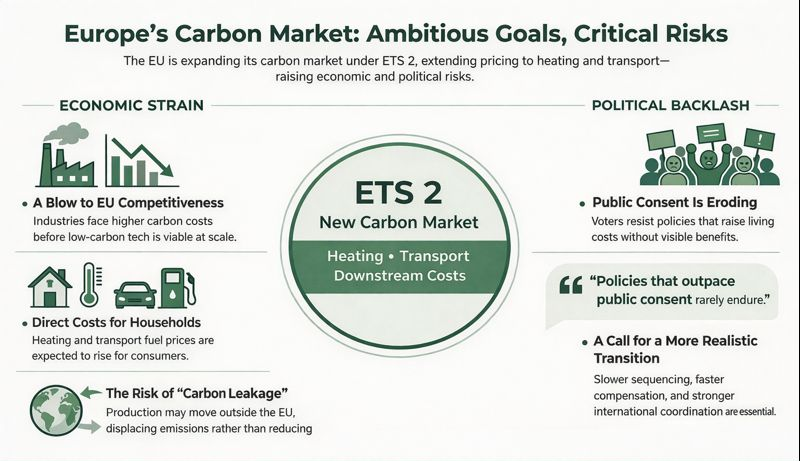
ETS 2, as it is known, is due to launch in 2028 following a year-long delay. Road transport fuels (gasoline, diesel) will be included, as well as heating fuels for buildings (natural gas, oil, coal). Aluminium is covered by the original ETS, but these new costs are expected to be passed downstream to businesses and consumers, effectively putting a price on carbon across the broader economy. There will be a price cap of EUR 45 per tonne of CO2 in the initial years, but the system is expected to tighten over time, with fewer free allocations and increased demand driving up the price of allowances.
The new ETS risks placing significant strain on European businesses and consumers while testing the political durability of the EU’s climate strategy.
A new blow to EU competitiveness
For Europe’s energy-intensive industries, the revised ETS represents a material shift in cost structures. The faster phase-out of free allowances will expose sectors to higher carbon prices well before commercially viable low-carbon technologies are available at scale.
CBAM compounds the problem
The issue is exacerbated by the EU’s insistence on introducing a Carbon Border Adjustment Mechanism (CBAM): a wrong-headed initiative that will lead to negative consequences for the European economy, businesses and consumers, as well as upset global trading partners. CBAM should be scrapped immediately, but the EU appears to be doubling down on its green mistake.
At present, faced with rising carbon costs, volatile energy prices and uncertain demand, companies may well defer capital expenditure or shift production outside the EU. The result would be diminished industrial capacity in Europe, without a commensurate reduction in global emissions.
The consumer impact is more immediate
While industrial costs tend to be diffuse and indirect, the expansion of carbon pricing to buildings and road transport through the new ETS 2 will be highly visible to households. Carbon pricing in these sectors will translate into higher heating and fuel costs. Although EU policymakers emphasise that revenues will be recycled through the Social Climate Fund and national compensation schemes, these mechanisms are complex, unevenly applied and often delayed.
Consumers, by contrast, experience price signals immediately. For lower-income households and those in rural or peripheral regions, transport and heating costs represent a substantial share of monthly expenditure. In this context, assurances of future redistribution may offer limited reassurance. Europe has seen before how climate policies perceived as regressive or technocratic can provoke political backlash. If carbon pricing is felt primarily as a cost rather than a transition, public support will erode.
Europe cannot decarbonise in isolation
A further structural weakness of the revised ETS lies in the assumption that Europe can move significantly faster than its trading partners without economic consequences.
The EU produces less than a tenth of global emissions. If stricter carbon pricing reduces European output while imports from less regulated regions fill the gap, the climate benefit will be limited. Emissions may simply be displaced rather than eliminated.
This is not an argument against climate action, but against unilateral acceleration without sufficient international coordination or technological readiness. Carbon pricing is most effective when low-carbon alternatives are available, infrastructure is in place and competitors face similar constraints.
The political risk is growing
The most significant risk posed by the revised ETS is political. Climate policy depends not only on regulatory design but on public consent. When voters associate decarbonisation with higher living costs, industrial decline or policy overreach, resistance hardens.
Across Europe, cost-of-living pressures remain acute. In that environment, policies that raise prices, even in the service of long-term goals, face heightened scrutiny. If the ETS comes to symbolise economic strain rather than environmental progress, it will weaken support not only for carbon markets but for climate policy as a whole.
A more credible transition
Europe’s climate ambition must be matched with sequencing and realism. A slower withdrawal of free allowances, stronger safeguards against carbon leakage, clearer and faster consumer compensation and greater emphasis on enabling infrastructure would strengthen the system’s legitimacy. So too would deeper coordination with international partners.
The risk facing Europe is not inadequate climate ambition, but insufficient attention to economic and political constraints. If the revised ETS imposes visible costs on businesses and households without delivering equally visible benefits, it may undermine the very transition it is meant to support.
Climate leadership ultimately requires durability. Policies that outpace public consent rarely endure.
Also read: Europe should dismantle its wrong-headed plans for a carbon wall