
The recent Supreme Court ruling limiting the use of emergency economic powers to impose broad tariffs has been widely interpreted through a political lens. For the aluminium industry, however, the implications are less about politics and more about structure. The decision does not eliminate trade policy tools, nor does it dismantle Section 232 measures on aluminium. What it does is something more subtle and more consequential: It reintroduces uncertainty into the legal architecture underpinning parts of the US trade enforcement. And for an industry that has spent the better part of a decade navigating tariffs, exemptions, quotas and retaliatory measures, that uncertainty deserves careful strategic reflection.
From protection to durability: Rethinking competitiveness
The immediate instinct in moments like this is to ask whether protection will weaken or persist. That is a short-term question. The more important question is whether the US aluminium competitiveness rests on foundations that can withstand judicial review, electoral cycles and policy recalibration. If the answer is yes, the ruling is a manageable adjustment. If the answer is no, then the ruling is a reminder that structural strength cannot be outsourced to temporary legal authorities.
Tariffs as variables, not constants
Over the past several years, tariffs have played a visible role in reshaping the aluminium landscape in the US. Section 232 measures were justified on national security grounds and created a framework that altered import flows, pricing dynamics and investment incentives. They provided breathing room for domestic producers, influenced downstream cost structures and sent a signal that aluminium was viewed as strategically important. Regardless of one’s perspective on their effectiveness, there is little doubt that tariffs became embedded in market expectations.
Image used for representational purpose
Yet tariffs, by definition, are policy instruments. They are variables, not constants. They can be expanded, reduced, reinterpreted, or challenged. When the Supreme Court signals limits on certain executive authorities, it does not necessarily undo existing sector-specific measures, but it reminds every industrial participant that trade architecture is not immutable. For aluminium producers, recyclers, fabricators and consumers, that reminder should shift the focus from protection as a shield to competitiveness as a design principle.
The structural realities of primary aluminium production
Primary aluminium in the US operates within a unique set of constraints. It is capital-intensive, energy-intensive and highly sensitive to long-term power pricing. Smelters cannot be turned on and off in response to quarterly price fluctuations without high cost. They require multi-decade confidence in electricity supply, regulatory clarity and stable customer demand. Tariffs may improve price realisations at the margin, but they do not change the fundamental physics of smelting. Electricity remains the decisive variable.
Using protection time wisely: A strategic audit for producers
If tariff regimes become more legally or politically fluid, primary producers face a strategic crossroads. The relevant question is not whether protection should exist. The relevant question is whether the industry has used periods of protection to strengthen its structural position. Have investments in energy contracts, modernisation, carbon intensity reduction and operational efficiency progressed sufficiently to sustain competitiveness in a less predictable policy environment? Or has the industry primarily relied on tariff premiums to stabilise margins?
This is not a criticism; it is a strategic audit. Every protected industry faces the same challenge. Protection can create time. What matters is how that time is used. If it is used to improve productivity, reduce costs, deepen customer integration and secure energy advantages, then the industry emerges more resilient. If it is used merely to preserve status quo capacity, then resilience remains limited.
The Supreme Court’s ruling indirectly reinforces a principle that sophisticated industrial sectors already understand: Legal durability is not the same as competitive durability. A measure that survives one administration may not survive another. An authority upheld in one context may be narrowed in another. Building an aluminium strategy that assumes policy permanence is therefore risky. Building one that assumes volatility is prudent.
Also read: The US aluminium industry: When uncertainty becomes the business model
Secondary aluminium’s structural advantage
Secondary aluminium presents an instructive contrast. Recycling is not immune to market forces, nor is it unaffected by trade policy. Scrap flows respond to price signals and export dynamics can influence domestic availability. However, the core competitive advantage of recycling is not rooted in tariff protection. It is rooted in energy efficiency and capital flexibility. Producing secondary aluminium requires a fraction of the energy required for primary production. Facilities are generally less capital-intensive, faster to scale and more adaptable to regional supply conditions.
In an environment where tariff authorities may evolve, that intrinsic efficiency becomes strategically valuable. Secondary production does not depend on emergency economic powers to justify its existence. Its value proposition is anchored in physics, cost structure and increasingly, carbon intensity. As corporate buyers, automakers, beverage companies and technology firms prioritise lower embodied carbon and supply chain resilience, recycled aluminium aligns naturally with those objectives.
This does not mean that primary aluminium lacks strategic importance. On the contrary, domestic primary capacity retains clear national security relevance, particularly for defence, aerospace and critical infrastructure applications. But if the justification for primary investment rests heavily on protection rather than productivity, long-term sustainability becomes more fragile. A judicial recalibration of tariff authority highlights that fragility without necessarily causing it.
Downstream manufacturers and the complexity of tariff uncertainty
Downstream producers, like rolling mills, extruders, foundries and fabricators, occupy an even more complex position. They sit at the intersection of primary and secondary supply, and they compete in global product markets where margins are often thin. For them, tariff uncertainty can alter input costs, export competitiveness and customer pricing strategies simultaneously. A court ruling that narrows one pathway of tariff implementation while leaving others intact adds layers of scenario planning. It requires commercial contracts that incorporate flexibility, sourcing strategies that diversify risk and capital allocation decisions that assume regulatory variability.
Redefining competitiveness in 2026
From a broader industrial policy perspective, the ruling invites reflection on what true competitiveness means in 2026. Is competitiveness defined by the ability to secure protective measures when global prices fall? Or is it defined by the ability to operate efficiently regardless of external policy shifts? The most robust industrial systems tend to combine selective strategic support with relentless internal efficiency. They do not assume that one will permanently compensate for the absence of the other.
The global aluminium landscape reinforces this lesson. China’s dominance in aluminium was not built solely on trade policy; it was built on coordinated energy policy, infrastructure investment and scale. Other producing nations integrate power generation and metal production to stabilise costs. In that context, the US aluminium must consider whether its comparative advantage lies in protection, innovation, energy strategy, recycling sophistication or a combination of all four.
Energy strategy as the decisive lever
Energy remains central. Even with tariffs in place, high electricity costs can erode gains. Conversely, competitively priced, low-carbon power can strengthen domestic production regardless of trade measures. If judicial decisions make certain tariff tools less predictable, the relative importance of energy contracts, grid reliability and long-term power purchase agreements increases. These are structural levers, not temporary ones.
Scrap as a strategic resource
At the same time, recycling infrastructure in the US continues to present both opportunity and vulnerability. Beverage cans remain one of the most recyclable consumer products, yet recycling rates have declined from historical highs. This gap between potential and performance suggests that supply-side efficiency is only part of the equation. Collection systems, consumer behaviour, deposit programs and scrap processing quality all influence the volume and purity of feedstock available to secondary producers.
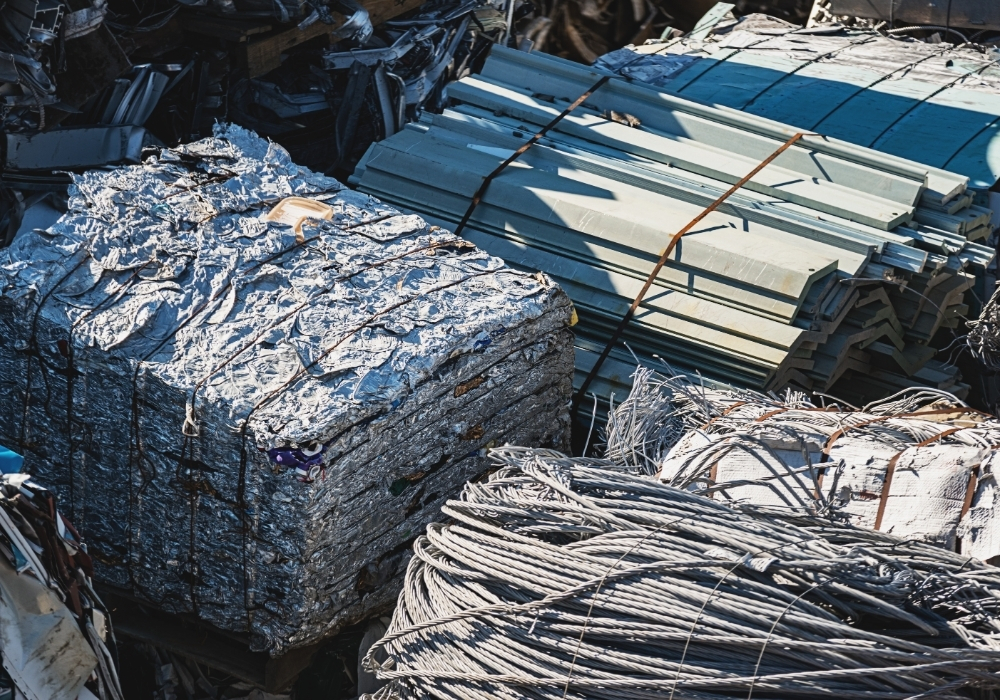
Image used for representational purpose
In a policy environment where tariff tools may shift, improving domestic scrap recovery becomes strategically significant. Scrap that is not collected is not available to support domestic manufacturing. Scrap that is exported may reduce feedstock security for the US mills. Treating high-quality scrap streams as strategic resources is not a protectionist impulse; it is a recognition that circular material flows enhance industrial resilience. The more efficiently the US captures and processes its own aluminium scrap, the less exposed it becomes to both import volatility and legal uncertainty around trade measures.
Beyond policy visibility: The real drivers of industry performance
There is also a psychological dimension to the Supreme Court’s ruling. For years, aluminium has been part of high-visibility trade debates. That visibility can create the impression that policy is the primary driver of industry outcomes. In reality, the industry’s trajectory is shaped by a complex mix of factors: Energy markets, capital costs, technological upgrades, environmental regulation, customer preferences and global demand cycles. Trade policy influences these variables, but it does not replace them.
A competitive industry should not fear judicial scrutiny. It should be designed to endure it. When courts clarify the limits of executive authority, they reinforce constitutional processes. For businesses, that means recalibrating expectations and planning within the clarified framework. It does not mean abandoning the strategy. It means refining it.
Three strategic lessons for the industry
Looking ahead, the most successful aluminium players in the United States are likely to be those who internalise three lessons from this moment. First, policy support, where available, should be viewed as an accelerant rather than a foundation. It can catalyse investment, but it cannot substitute for operational excellence. Second, structural advantages, like energy efficiency, low carbon intensity, supply chain integration and recycling depth, outlast legal debates. Third, resilience requires optionality: Diversified sourcing, adaptable production and commercial contracts that anticipate volatility rather than assume stability.
Building competitiveness that outlasts policy cycles
The Supreme Court ruling is therefore less a disruption than a diagnosis. It reveals where assumptions may have hardened into expectations. It tests whether strategic plans are robust enough to handle legal recalibration. It underscores that in aluminium, as in all capital-intensive industries, the long game is determined by cost curves and operational discipline more than by headlines.
In practical terms, this means continued investment in modernising smelters where energy conditions justify it. It means expanding recycling capacity and improving scrap collection infrastructure. It means integrating carbon accounting into product offerings as buyers increasingly differentiate on emissions. It means deepening partnerships with end-use sectors, like automotive, construction, packaging, aerospace and data infrastructure, so that demand signals are clearer and more stable.
Above all, it means recognising that competitiveness cannot be episodic. It cannot depend on the persistence of any single tariff authority. If tariff authority expands, contracts, or evolves, the industry must still stand on fundamentals. Those fundamentals include access to reliable power, efficient plants, disciplined capital allocation, skilled labour, advanced processing technology and a circular material base that reduces exposure to primary cost volatility.
The aluminium industry has navigated decades of change, energy crises, globalisation, environmental regulation and technological shifts. A judicial clarification of trade authority is another chapter in that evolution. It should not provoke alarm. It should provoke analysis.
If tariffs are strengthened, weakened, or recalibrated over time, the question will remain the same: Is the US aluminium structurally competitive? If the answer is grounded in energy strategy, recycling efficiency and industrial discipline, then policy variability becomes manageable. If the answer depends primarily on the endurance of protective measures, then every court decision, election or regulatory reinterpretation will feel existential. The Supreme Court has reminded the market that legal tools are subject to review. The industry now has an opportunity to remind itself that durable competitiveness is built elsewhere. In aluminium, the most reliable advantage is not temporary insulation from global forces. It is the capacity to operate efficiently within them.